Description
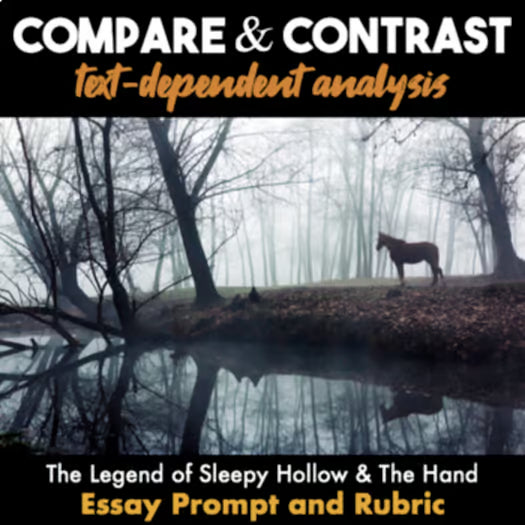
This paired texts analysis lesson focuses on The Legend of Sleepy Hollow by Washington Irving and The Hand by Guy de Maupassant, two classic nineteenth-century short stories that work exceptionally well for Text-Dependent Analysis (TDA) and Response to Literature (RTL) writing. This resource is designed for middle school and high school ELA classrooms and provides structured practice with compare and contrast analysis and evidence-based writing.
Both stories are gothic in nature and explore enduring themes such as imagination versus reality, fear, storytelling, and the supernatural. While The Legend of Sleepy Hollow is also a key example of American Romanticism and satire, both texts challenge readers to question perception, belief, and truth. Comparing these stories gives students meaningful opportunities to analyze how authors from the same historical period approach similar ideas using different narrative styles and techniques.
Students use a guided graphic organizer to compare multiple literary elements across both texts, preparing them for analytical writing. They then respond to a Response to Literature or Text-Dependent Analysis essay prompt, supported by a standards-based rubric aligned with Common Core expectations. An answer guide is included to support instruction, discussion, and assessment.
Throughout the lesson, students practice analyzing theme, comparing text structure, and citing strong textual evidence to support both explicit ideas and inferred meaning. Emphasis is placed on drawing conclusions grounded in the text and supporting analysis with accurate evidence. Students also examine key literary devices, including plot, conflict, theme, characterization, point of view, text structure, mood, tone, and symbolism.
This paired texts TDA lesson is ideal for gothic literature units, short story analysis, essay writing instruction, and standards-based literary analysis. Both print-ready PDF and editable Word document versions of key materials are included for flexible classroom use.
Chomping at the Lit
Paired Texts — The Legend of Sleepy Hollow and The Hand TDA Essay
Paired Texts — The Legend of Sleepy Hollow and The Hand TDA Essay
📦 This download is delivered as a ZIP file
Couldn't load pickup availability
Get your evenings back.
Less planning. More living.
Make every resource in my store yours.
 EXPLORE ALL-ACCESS →
Just $29.99/month · Cancel anytime
✓ Unlimited downloads. Yours to keep forever.
Description
This paired texts analysis lesson focuses on The Legend of Sleepy Hollow by Washington Irving and The Hand by Guy de Maupassant, two classic nineteenth-century short stories that work exceptionally well for Text-Dependent Analysis (TDA) and Response to Literature (RTL) writing. This resource is designed for middle school and high school ELA classrooms and provides structured practice with compare and contrast analysis and evidence-based writing.
Both stories are gothic in nature and explore enduring themes such as imagination versus reality, fear, storytelling, and the supernatural. While The Legend of Sleepy Hollow is also a key example of American Romanticism and satire, both texts challenge readers to question perception, belief, and truth. Comparing these stories gives students meaningful opportunities to analyze how authors from the same historical period approach similar ideas using different narrative styles and techniques.
Students use a guided graphic organizer to compare multiple literary elements across both texts, preparing them for analytical writing. They then respond to a Response to Literature or Text-Dependent Analysis essay prompt, supported by a standards-based rubric aligned with Common Core expectations. An answer guide is included to support instruction, discussion, and assessment.
Throughout the lesson, students practice analyzing theme, comparing text structure, and citing strong textual evidence to support both explicit ideas and inferred meaning. Emphasis is placed on drawing conclusions grounded in the text and supporting analysis with accurate evidence. Students also examine key literary devices, including plot, conflict, theme, characterization, point of view, text structure, mood, tone, and symbolism.
This paired texts TDA lesson is ideal for gothic literature units, short story analysis, essay writing instruction, and standards-based literary analysis. Both print-ready PDF and editable Word document versions of key materials are included for flexible classroom use.
Description
This paired texts analysis lesson focuses on The Legend of Sleepy Hollow by Washington Irving and The Hand by Guy de Maupassant, two classic nineteenth-century short stories that work exceptionally well for Text-Dependent Analysis (TDA) and Response to Literature (RTL) writing. This resource is designed for middle school and high school ELA classrooms and provides structured practice with compare and contrast analysis and evidence-based writing.
Both stories are gothic in nature and explore enduring themes such as imagination versus reality, fear, storytelling, and the supernatural. While The Legend of Sleepy Hollow is also a key example of American Romanticism and satire, both texts challenge readers to question perception, belief, and truth. Comparing these stories gives students meaningful opportunities to analyze how authors from the same historical period approach similar ideas using different narrative styles and techniques.
Students use a guided graphic organizer to compare multiple literary elements across both texts, preparing them for analytical writing. They then respond to a Response to Literature or Text-Dependent Analysis essay prompt, supported by a standards-based rubric aligned with Common Core expectations. An answer guide is included to support instruction, discussion, and assessment.
Throughout the lesson, students practice analyzing theme, comparing text structure, and citing strong textual evidence to support both explicit ideas and inferred meaning. Emphasis is placed on drawing conclusions grounded in the text and supporting analysis with accurate evidence. Students also examine key literary devices, including plot, conflict, theme, characterization, point of view, text structure, mood, tone, and symbolism.
This paired texts TDA lesson is ideal for gothic literature units, short story analysis, essay writing instruction, and standards-based literary analysis. Both print-ready PDF and editable Word document versions of key materials are included for flexible classroom use.